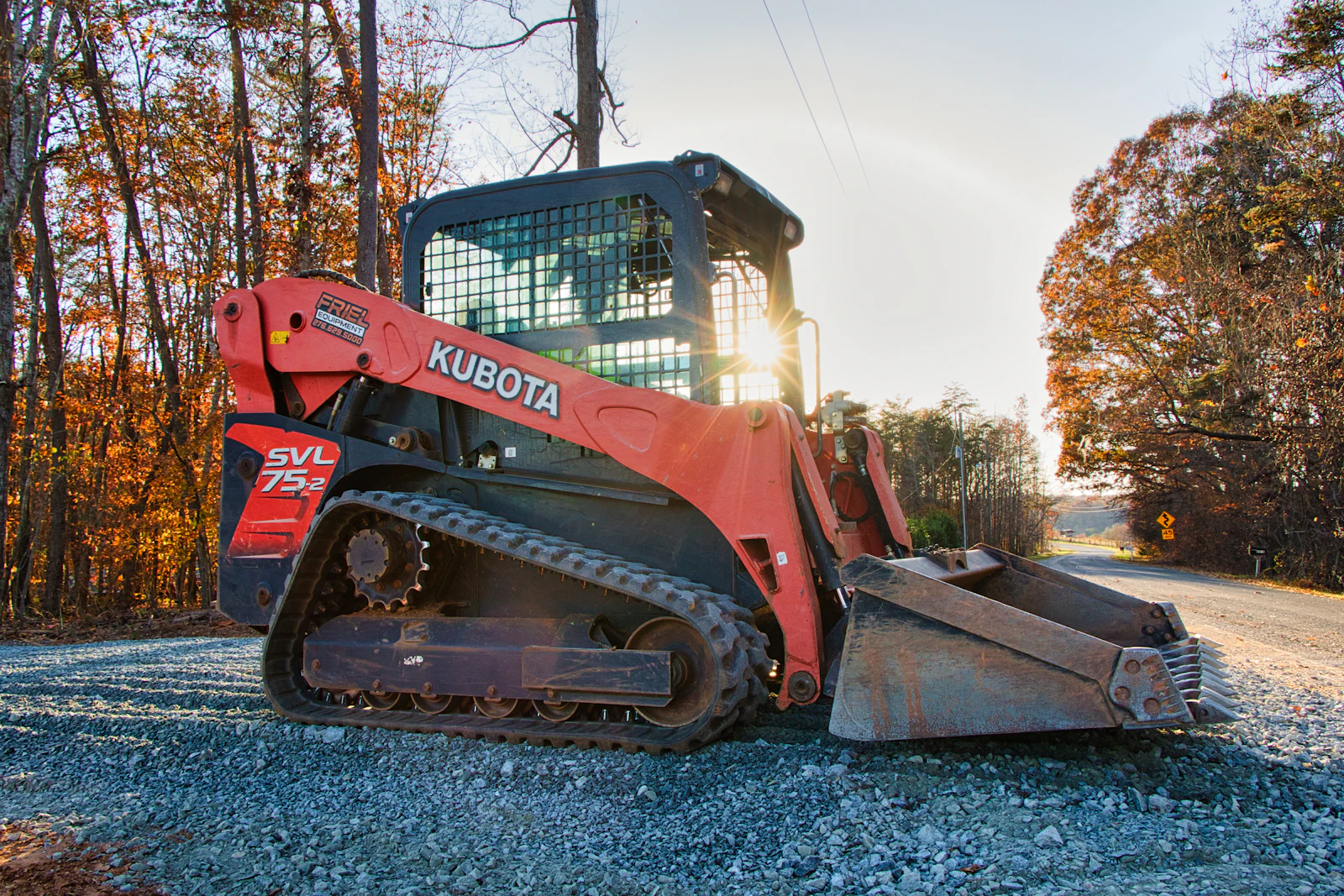
For Kansas City concrete driveway work in 2026, budget skid steer loader equipment hire costs (machine only) in the range of $265–$450/day, $800–$1,350/week, and $1,900–$3,100 per 4-week period, assuming a mid-size wheeled skid steer (roughly 1,400–3,100 lb ROC) with standard hydraulics and typical 1-shift usage. If site conditions push you to a compact track loader (common in KC’s wet clay soils and shoulder-season mud), planning ranges are typically higher—often $290–$525/day, $900–$1,575/week, and $2,050–$3,800 per 4-week. These are planning ranges for 2026 budgeting; final pricing will depend on model class, delivery radius across the MO/KS metro, protection plan/insurance, attachments (breaker/planer), and the rental house’s billing rules. In Kansas City you’ll commonly see fleets and support from providers like KC Bobcat as well as national rental networks (e.g., United Rentals, Sunbelt Rentals, and Herc Rentals) competing on availability, logistics, and damage coverage rather than just headline day rates.
| Vendor |
Daily Rate |
Weekly Rate |
Review Score |
Website |
| United Rentals |
$430 |
$1 580 |
9 |
Visit |
| Sunbelt Rentals |
$415 |
$1 520 |
8 |
Visit |
| Foley Equipment (CAT Rental / Foley Rental) |
$395 |
$1 450 |
9 |
Visit |
| Bledsoe’s Rental (Waldo / Wornall Rd) |
$235 |
$700 |
8 |
Visit |
| Murphy Tractor & Equipment Co. |
$405 |
$1 490 |
9 |
Visit |
Skid Steer Loader Hire Costs Kansas City 2026
If you need a defensible baseline for a Kansas City estimate, published local rate cards are the cleanest starting point, then you scale to your 2026 planning assumption (many contractors carry a +5% to +15% escalation allowance over older posted rate cards depending on utilization, season, and fleet age). A KC-area example rate card (KC Bobcat) lists skid-steer day/week/4-week pricing by model class and also calls out key commercial terms that materially change true hire cost (shift hours, minimums, protection plan, cleaning, and fuel).
Published Kansas City example rates (wheeled skid-steer class):
- Small-frame skid steer (e.g., S450 class, ~1,370 lb ROC): about $240/day, $720/week, $1,728/4-week.
- Mid-frame skid steer (e.g., S66/S595 class, ~2,400 lb ROC): about $260/day, $780/week, $1,872/4-week.
- Larger mid-frame (e.g., S650 class, ~2,690 lb ROC): about $280/day, $840/week, $2,016/4-week.
- Large-frame (e.g., S740/S770 class, ~3,100 lb ROC): about $370/day, $1,110/week, $2,664/4-week.
Those published numbers are useful not because you should expect the exact same rate in every 2026 quote, but because they show the “shape” of the pricing curve (small-frame vs large-frame) and where your estimate will tip from daily to weekly (often around the third day of use). They also confirm the unit of measure for long-term billing as a 4-week (28-day) period rather than a calendar month, which matters when your driveway schedule lands across month-end.
Published Kansas City example rates (compact track loader alternative, often chosen for muddy subgrade access):
- Entry compact track loader (e.g., MT85/MT100 class): about $265/day, $795/week, $1,908/4-week.
- Mid-size CTL (e.g., T450 class): about $315/day, $945/week, $2,268/4-week.
- Large CTL (e.g., T76 class): about $420/day, $1,260/week, $3,024/4-week.
- High-capacity CTL (e.g., T740/770 class): about $480/day, $1,440/week, $3,456/4-week.
For concrete driveway contractors, the CTL numbers matter even if you asked for a skid steer loader specifically: if you’re working after rain, staging spoils on soft lawn, or you must avoid rutting along the approach, an estimator may intentionally carry the higher tracked rate to protect schedule risk and back-charge risk from restoration.
What Typically Drives Skid Steer Hire Pricing For A Concrete Driveway In Kansas City?
Concrete driveway scopes tend to push skid-steer hire costs up because you’re not just “moving dirt.” You’re usually combining (1) demolition support, (2) heavy loading/hauling cycles, and (3) base conditioning/finish grading. The cost drivers below are what rental coordinators should map directly into the estimate, because they change the final invoice even when the day rate is fixed.
- Frame size / ROC selection: Moving broken concrete efficiently usually pulls you into a mid-to-large frame unit (often 2,400–3,100 lb ROC) so you’re not wasting hours on under-bucket loads. Larger frame also affects delivery class and tire/track wear exposure.
- Shift-hour limits: Many rental programs define “base rate” as 8 hours/day, 40 hours/week, and 160 hours per 4-week. If your driveway demo crew runs long days to hit pour windows, you can trigger overtime/overuse billing.
- Seasonal KC scheduling realities: Thunderstorm delays can extend off-rent by 1–2 days if you can’t backfill/grade to release the machine. In winter, frozen subgrade and higher breakout effort can increase fuel burn and cleanup time (higher chance of cleaning fees).
- Attachment requirement: If you need a hydraulic breaker, cold planer, grapple bucket, sweeper, or forks, those adders can rival the machine rate (especially breakers/planers).
Rental Term Assumptions That Change The Invoice (Not Just The Rate)
Most “rate” discussions miss the contractual mechanics that determine how many days you actually get billed for.
- One-day minimum: Many programs are explicit: no hourly rates and a one-day minimum. If your haul truck is late and you only use the skid steer for 2 hours, it can still be a full-day charge.
- Time-out to time-back billing: If billing is based on “time out/time back,” then a Friday afternoon pickup with a Monday morning return can be billed as the full weekend depending on the branch’s rules and whether off-rent was processed before cutoff.
- 4-week billing quirks: Some local cards note that after the third week, the fourth week is free (effectively encouraging 4-week terms). This is a major lever for driveway programs where you’re stringing multiple small jobs and can keep utilization high across the same machine.
- Overtime / extra shift use: A common national method is to bill excess hours at an hourly fraction of the base rate (for example, 1/8 of the daily charge per extra hour on daily rentals; 1/40 of the weekly on weekly rentals; 1/160 of the 4-week on 4-week rentals). Even if your local supplier uses a different method, carrying this as a contingency makes your estimate more realistic for tight pour schedules.
Kansas City Logistics: Delivery Radius, Site Access, And Neighborhood Constraints
In the KC metro, equipment logistics are a real cost center. The Missouri/Kansas state line also means your “Kansas City” address may land in a different tax jurisdiction and a different branch delivery zone than expected. Build your estimate around these realities:
- Delivery/pickup: Budget a combined $250–$450 round-trip delivery/pickup for a skid steer in-metro as a planning allowance. For a defensible benchmark, one public-agency rate schedule shows $150 delivery and $150 pickup for a rubber-tire skid steer on that contract.
- Delivery windows: Many branches run fixed windows (commonly morning vs afternoon). Missing a cutoff can add a same-day re-delivery or “failed delivery” trip charge (carry $75–$150 contingency if your projects often have gated access or concrete trucks blocking drives).
- Street/drive protection: Concrete driveway replacements in older KC neighborhoods often require sidewalk/curb protection and driveway approach protection. Carry 8–12 sheets of 3/4" plywood or composite mats in your plan; if you rent mats, budget $10–$25 per mat/day equivalent as a job-cost allowance (varies widely by provider and whether you supply your own).
Attachments And Adders Common On Concrete Driveway Scopes
For a concrete driveway replacement, the skid steer is often the material-handling backbone while your saws and breakers do the separation. If you need the skid steer to do the breaking itself, price attachments as first-class line items. Example published attachment rates from a KC-area rate card (loader attachments) include:
- Breaker (500 ft-lb class): about $215/day, $645/week, $1,548/4-week.
- Breaker (750 ft-lb class): about $240/day, $720/week, $1,728/4-week.
- Grapple bucket: about $190/day, $570/week, $1,368/4-week.
- Pallet forks: about $90/day, $270/week, (4-week listed around) $648.
- Sweeper: about $190/day, $570/week, $1,368/4-week (useful for final cleanup and minimizing silica-related dust migration offsite).
- Rock bucket: about $165/day, $495/week, $1,188/4-week (helpful when you’re separating base material).
Not every driveway job needs these, but when they do, omitting them is one of the fastest ways to blow your equipment hire budget.
Protection Plan, Insurance, Fuel, And Cleaning: The Non-Negotiables
Driveway crews tend to treat “damage waiver” as a checkbox, but for concrete scopes it’s a pricing driver because you’re operating around rebar, wire mesh, broken slabs, and often on tight residential access.
- Rental protection plan (RPP) / waiver: One KC-area program indicates that if proof of insurance is not provided, a 15% protection-plan fee can be applied to the total equipment rental charge. If you already carry coverage and can provide a certificate, you may avoid this fee—confirm before issuing the PO.
- Fuel (diesel): Many programs charge per gallon if not returned full. For estimating, carry 8–15 gallons/day for typical driveway loading/grading cycles, and 15–25 gallons/day if you’re running a breaker hard (higher RPM and hydraulic demand). If your internal fuel cost is $4.75–$6.25/gal in 2026 budgeting, your fuel line can easily be $40–$155/day depending on duty cycle.
- Cleaning fees: Concrete work is high-risk for cleanup charges (slurry, splatter, tracked-in paste). Some local terms explicitly note that a cleaning fee can apply for excessive concrete/asphalt contamination. Carry a cleanup allowance of $95–$250 per event if your returns are frequently end-of-day with no washout access.
- Environmental/administrative charges and tax: Many rental invoices include separate line-item surcharges. Without claiming any single vendor’s exact percentage, a conservative estimator often carries 2%–5% for environmental/administrative fees plus applicable local sales taxes (which can differ MO vs KS-side).
Estimator note for Kansas City concrete driveway programs: If you routinely stage spoils and base on-site overnight, pre-plan where the skid steer will park to avoid HOA/neighbor complaints and reduce theft exposure. Theft and vandalism can turn into a full replacement charge under standard rental terms if not covered by your policy.
Hidden-Fee Breakdown
To keep skid steer loader equipment hire costs predictable on concrete driveway scopes, treat the items below as “expected” rather than “surprises,” and build them into the job cost code up front.
- Delivery and pickup: Commonly billed separately from the rental rate; carry $150–$225 each way in-metro depending on distance, access, and whether a trailer swap is needed. A public contract example shows $150 delivery and $150 pickup for a rubber-tire skid steer.
- Weekend/holiday billing exposure: If “time out to time back” spans a weekend, you can be billed for non-working days. A practical control is to schedule pickup Monday–Thursday and return before the branch’s documented cutoff (often around 10:00 a.m.–2:00 p.m. depending on location) so off-rent can be processed the same day.
- Overuse/overtime: If your crew runs beyond 8-hour shifts to hit a pour, carry an overuse allowance. One common structure bills daily-rental overuse at 1/8 of the daily charge per extra hour. On a $370/day unit, that’s $46.25/hour for extra hours (example math for planning).
- Protection plan / waiver: Budget 15% of the rental charge if you cannot provide proof of insurance under programs that apply an RPP fee (confirm per supplier and per account).
- Fuel top-off: If returned short, many suppliers charge per gallon. Planning assumption: 10 gallons short at $6.00/gal internal cost = $60 swing, plus potential vendor admin markup.
- Concrete contamination cleaning: Carry $125 as a typical “likely” cleaning line if you do not have a washout plan; carry $250+ if you expect slurry in tracks/wheels, undercarriage buildup, or hardened splatter.
- Damage exposure (tires, glass, coupler, attachment wear): For driveway work, budget a self-insured retention allowance of $250–$750 for minor tire cuts, bent cutting edges, broken hydraulic couplers, or blown quick-connect seals—especially when working around rebar/mesh.
Example: 3-Day Concrete Driveway Demo Support And Base Prep (Kansas City)
Scenario: You have a 900 sq ft driveway replacement. Crew will sawcut and remove slabs; skid steer loads broken concrete into dump trailers, then regrades and conditions the base. Jobsite is on the KS-side with a narrow approach; you choose a large-frame skid steer for cycle time and add a breaker to speed edge removals.
- Machine: large-frame skid steer class at $370/day published example rate; for 3 days you should expect to hit the weekly equivalent in many rate structures ($1,110 is also the published weekly example for that class).
- Attachment: 750 ft-lb breaker at $240/day, which scales to a published $720/week if you keep it through the same period.
- Round-trip logistics: $300 total delivery + pickup (planning value aligned to a $150 + $150 benchmark).
- Protection plan (if no COI): 15% of rental charge. On $1,110 + $720 = $1,830, that’s $274.50.
- Environmental/admin: carry 3% planning allowance on rental line items = about $54.90 (assumption; verify by vendor).
- Fuel: assume 20 gallons consumed over the job at $5.50/gal internal cost = $110 (higher if breaker runs continuously).
- Concrete contamination cleanup: carry $125 allowance if returns often occur without washdown access.
Planning subtotal (pre-tax, illustrative): $1,830 rental + $300 logistics + $274.50 RPP + $54.90 env/admin + $110 fuel + $125 cleaning = $2,694.40. If the crew runs overtime—for example 12 hours/day for 2 days—carry an extra 8 hours overuse. Using the common 1/8 daily method on a $370/day unit adds roughly $370 in overuse.
How To Choose The Right Skid Steer For A Kansas City Driveway Crew (Cost-First)
From a rental coordinator’s view, the “right” unit is usually the one that minimizes billed days, not the one with the lowest daily rate.
- If you are hauling heavy broken concrete all day: price a larger-frame unit even if it’s $90–$130/day higher, because shaving 0.5–1.0 day off the schedule often saves more than the rate delta.
- If your site is soft or access crosses lawn: price a compact track loader instead of a wheeled skid steer to reduce restoration risk; restoration can exceed $500–$2,000 on a single front-yard rutting incident, which is usually more than the rental premium.
- If you need planing/sweeping: verify hydraulic requirements (standard vs high-flow) before you commit. High-flow capability can carry a higher hire rate and/or limit availability, which can force you into extra billed days waiting on the correct configuration.
Budget Worksheet
- Skid steer loader hire (wheeled) allowance: $265–$450/day (carry 3 days minimum for most driveway replacements).
- Weekly conversion allowance: if use reaches 3+ days, carry $800–$1,350/week for the machine.
- Breaker (if required) allowance: $215–$240/day or $645–$720/week depending on energy class.
- Pallet forks (handling forms/rebar bundles): $90/day allowance.
- Sweeper (dust/control and cleanup): $190/day allowance.
- Delivery + pickup (metro): $300 allowance (or $150 each way benchmark).
- Protection plan / damage waiver: 15% of rental if no COI (confirm).
- Environmental/admin surcharge: 3% planning allowance (verify on quote).
- Fuel: 10–25 gallons allowance per job depending on duty cycle at $4.75–$6.25/gal.
- Cleaning/pressure wash allowance: $125 (carry $250 for worst-case slurry/undercarriage buildup).
- Overuse contingency: 4–8 hours at ~$40–$55/hour equivalent on larger-frame daily rentals if you commonly run extended shifts.
Rental Order Checklist
- Confirm exact model class (ROC), tire type (pneumatic vs solid/foam-filled), and whether you need a compact track loader substitute if weather turns.
- PO must state rental term clearly (daily vs weekly vs 4-week), plus “authorized attachments” (breaker, forks, sweeper) to avoid field swaps that reset billing.
- Request and document branch cutoff times for: delivery scheduling, same-day off-rent processing, and after-hours returns.
- Provide COI if required to avoid automatic protection-plan charges (or explicitly approve the RPP line if you want it applied).
- Delivery instructions must include: gate codes, driveway width constraints, overhead obstructions, and a designated drop zone that does not block concrete truck access.
- At delivery: photo/video the machine (all sides), hour meter, fuel level, tire/track condition, quick-attach interface, and attachment serial numbers.
- Return requirements: full fuel, remove concrete splatter before it cures, clean couplers, cap hydraulic lines on attachments, and photograph condition at load-out.
- Off-rent procedure: confirm who is authorized to call off-rent, and require an off-rent confirmation number or email from the supplier.
Kansas City-Specific Cost Controls For Driveway Crews
- Cross-jurisdiction estimating: identify whether the site is Kansas City, MO vs Kansas City, KS (or a nearby municipality). Taxes and branch delivery zones can differ; treat this as a scope input, not an admin afterthought.
- Clay + rain reality: carry an alternate price for a track loader when rain is forecast; the incremental rental premium is often cheaper than yard restoration and schedule slips.
- Dust-control expectations: if you are working near an occupied garage or storefront, include sweeper time and disposal controls; silica-sensitive sites increase cleanup and may increase cleaning fee risk if the machine returns with hardened residue.
If you want, share (1) driveway size, (2) expected duration on site, (3) whether you’re breaking concrete with the skid steer or a dedicated breaker tool, and (4) whether delivery is MO-side or KS-side, and I’ll tighten the 2026 equipment hire budget to a more job-specific range.